
Shared custody can affect child support payments in New Mexico, but it does not automatically eliminate them. Even when parents divide parenting time equally or nearly equally, one parent may still be ordered to pay support.
That often surprises parents. A 50/50 schedule may feel like an equal division of responsibility, but parenting time is only one part of the child-support calculation. New Mexico courts may also consider each parent’s income, the number of children, work-related childcare costs, health-insurance premiums, extraordinary medical expenses, and other circumstances recognized under the state’s child-support guidelines.
The important point is that equal parenting time does not always mean equal financial circumstances. One parent may earn substantially more than the other. One parent may pay most of the child’s health-insurance premium or work-related daycare expenses. The actual parenting schedule may also differ from the arrangement described informally as “shared custody.”
For Albuquerque parents, determining the correct support amount usually requires more than counting overnight visits. The court must apply the appropriate New Mexico child-support worksheet using accurate financial and parenting-time information.
New Mexico Uses Child Support Guidelines
New Mexico uses statutory child-support guidelines to promote consistency and help ensure that children receive financial support from both parents.
The guidelines generally begin with the parents’ combined gross monthly income. The basic support obligation is then allocated between the parents based on their respective percentages of that combined income. The calculation may also include qualifying childcare, healthcare, and other child-related expenses.
The guidelines are meant to provide an organized method for calculating support, but they do not reduce every family to one simple number. The correct worksheet and financial inputs depend on the custody arrangement and the facts of the case.
New Mexico Courts provides different worksheets for different parenting arrangements:
- Worksheet A: Basic visitation
- Worksheet B: Shared responsibility
The Second Judicial District Court, which serves Albuquerque and Bernalillo County, provides both Worksheet A and Worksheet B as part of its family court materials.
A completed child-support worksheet is generally required when support is established or modified. The worksheet shows how the figures were entered and how the proposed obligation was calculated.
What Does Shared Custody Mean?
“Shared custody” is commonly used to describe an arrangement in which a child spends substantial time with both parents. However, several related legal terms are often confused.
Joint Legal Custody
Joint legal custody generally concerns decision-making authority. Parents may share responsibility for major decisions involving education, healthcare, religion, and other important areas of a child’s life.
Joint legal custody does not necessarily mean that the child spends exactly half of the time with each parent.
Physical Custody
Physical custody refers to where the child lives and how parenting time is divided. One parent may have the child for most school nights while the other has alternating weekends, holidays, or extended summer periods.
Parenting Time
Parenting time is the actual schedule under which the child is in each parent’s care. The schedule may be expressed through overnights, days, weekends, holidays, school breaks, and summer periods.
Equal Parenting Time
Equal parenting time usually refers to an arrangement in which the child spends approximately the same amount of time with each parent. Common examples include alternating weeks or schedules that divide the week between the two households.
Shared Responsibility for Child-Support Purposes
Shared responsibility is a specific child-support concept associated with Worksheet B. It should not be assumed to apply merely because an order uses the phrase “joint custody.”
The actual parenting arrangement matters. A court may examine the custody plan, the number of days or overnights in each household, and whether both parents truly provide substantial day-to-day care.
Does 50/50 Custody Eliminate Child Support?
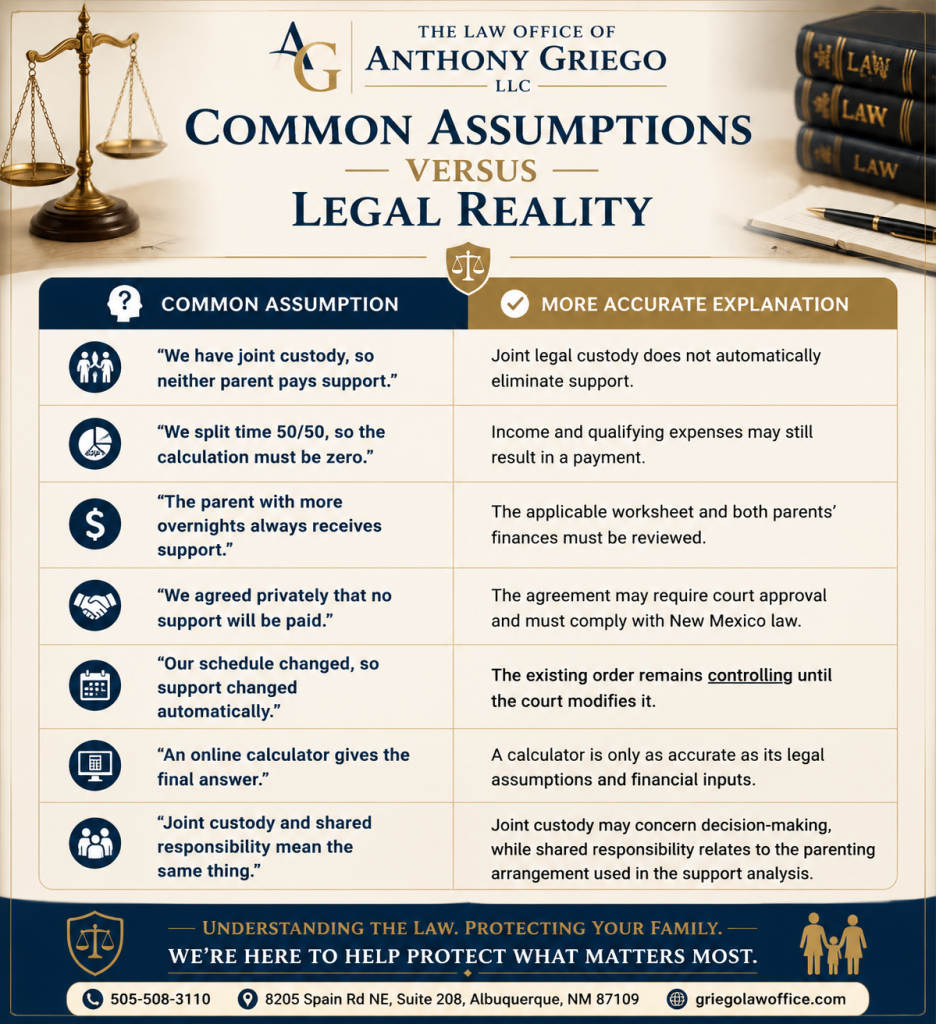
No. A 50/50 parenting schedule does not automatically eliminate child support in New Mexico.
New Mexico Courts explains that even under a shared-responsibility arrangement, one parent may still be required to pay support to the other.
The reason is straightforward: child support is intended to help meet the child’s needs across both households. Equal parenting time does not necessarily mean that the parents have equal incomes, equal household resources, or equal child-related expenses.
Consider a simplified example:
- Parent A earns $8,000 per month.
- Parent B earns $3,000 per month.
- The parents divide parenting time equally.
- Parent B pays most of the work-related childcare expenses.
Although the parenting schedule is equal, the parents’ financial circumstances are not. A support payment may still be appropriate after the guideline calculation is completed.
The opposite can also occur. If the parents have similar incomes, divide parenting time equally, and share child-related expenses in comparable proportions, the resulting transfer payment may be relatively small. However, no parent should assume the result without completing the correct worksheet.
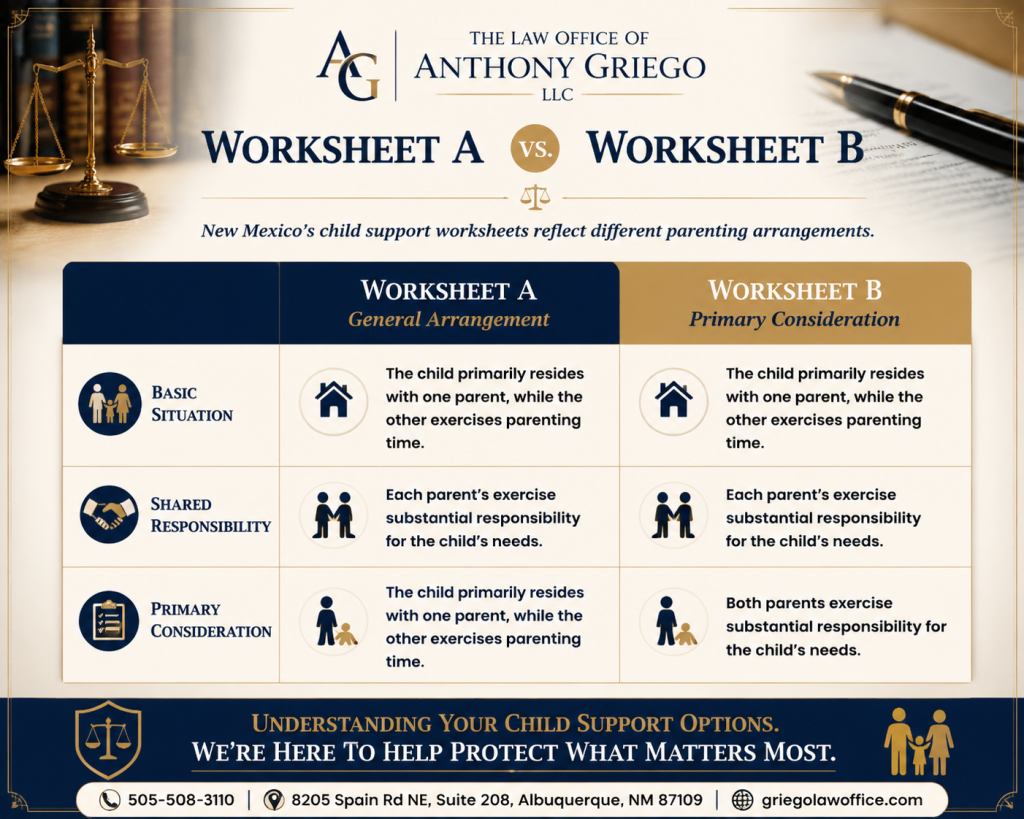
Worksheet A generally calculates the support obligation based on the parents’ combined income and allocates the obligation between them. The parent with whom the child does not primarily reside commonly makes a transfer payment to the other parent.
Worksheet B accounts for the fact that both parents directly support the child during substantial periods of parenting time. The worksheet calculates each parent’s responsibility and considers the amount each is presumed to retain for expenses while the child is in that parent’s household.
The correct worksheet should be chosen based on the legally recognized parenting arrangement—not simply on what one parent calls the schedule.
This distinction matters because using the wrong worksheet can produce a materially different result.
Joint Custody and Shared Responsibility Are Not the Same Thing
One of the most common child-support mistakes is assuming that joint custody automatically requires Worksheet B.
It does not.
Joint custody may address legal decision-making while the physical schedule remains closer to a primary-residence arrangement. For example, the parents may share educational and medical decisions, but the child may still live primarily with one parent during the school week.
Likewise, a parenting plan may appear equal on paper but operate differently in practice. One parent may regularly give up scheduled time because of work, travel, or other obligations. School, transportation, and extracurricular schedules may also affect how much responsibility each parent actually exercises.
When there is disagreement, the court may need to review:
- The written custody plan
- Scheduled overnights
- The child’s actual routine
- School-night responsibilities
- Transportation arrangements
- Holiday and summer schedules
- Each parent’s daily caregiving role
- Whether the current arrangement is temporary or permanent
How Income Affects Shared-Custody Child Support
Income remains a central part of the calculation even when parenting time is shared equally.
New Mexico generally considers each parent’s gross income. Depending on the circumstances, income may include more than base wages.
Potential income sources can include:
- Salary
- Hourly wages
- Overtime
- Commissions
- Bonuses
- Self-employment earnings
- Unemployment benefits
- Disability benefits
- Retirement income
- Rental income
- Recurring business distributions
- Other income recognized under applicable law
Both parents’ income figures are combined. Each parent’s percentage share of the combined income is then used in the support calculation.
For example, if one parent earns 70% of the parents’ combined income, that parent will generally be assigned a greater percentage of the child’s support obligation than the parent who earns 30%.
This does not mean the higher-earning parent always pays the exact difference. The applicable worksheet, parenting arrangement, healthcare costs, childcare expenses, and other adjustments must also be considered.
What Counts as Gross Income?
Gross income is not necessarily the same as take-home pay.
Parents sometimes enter net income—the amount deposited after taxes, insurance, retirement contributions, and other deductions—when attempting to calculate support. That can produce an inaccurate result.
The legal definition of income and allowable deductions must be applied carefully. The correct figure may differ depending on whether a parent is:
- Traditionally employed
- Self-employed
- Paid by commission
- Receiving bonuses
- Working seasonal hours
- Receiving unemployment
- Operating a closely held business
- Voluntarily unemployed or underemployed
Accurate income information is particularly important under Worksheet B because the calculation compares each parent’s support responsibility under a shared arrangement.
Bonuses, Overtime, and Commissions
Variable earnings can complicate a child-support calculation.
A parent may earn a stable base salary but receive substantial annual bonuses. Another may work unpredictable overtime or earn commissions that rise and fall throughout the year.
The court may need to review income over a reasonable period rather than relying on one paycheck. Relevant records may include:
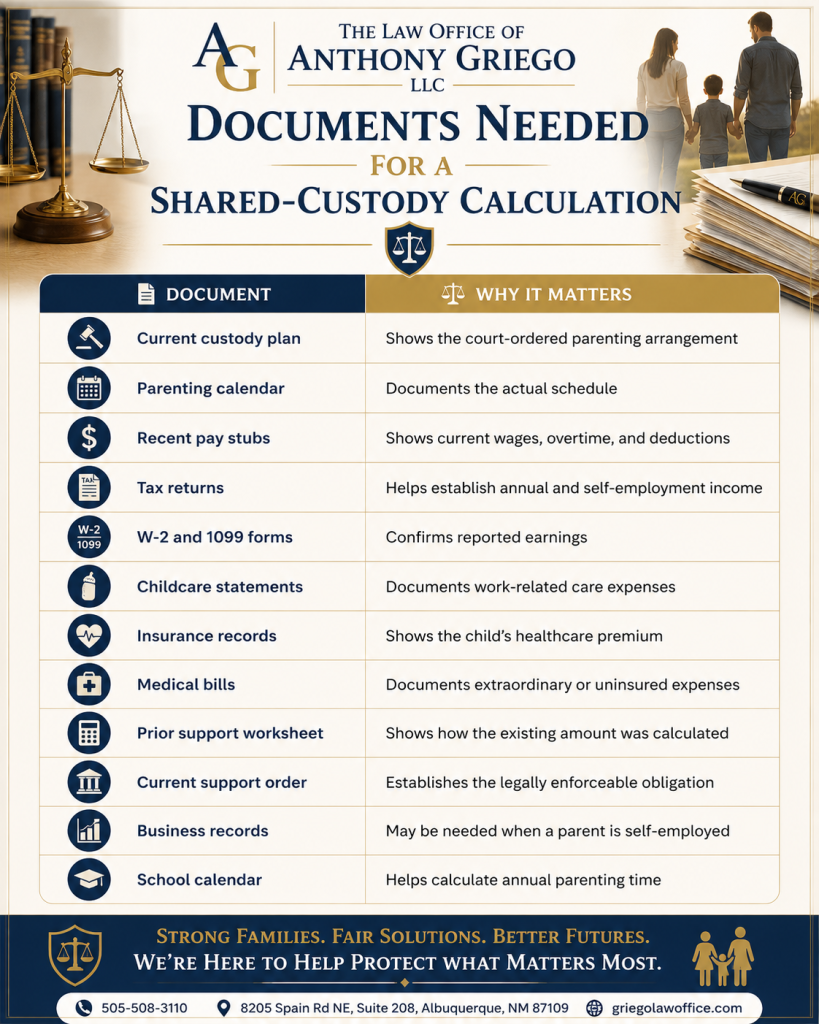
- Recent pay stubs
- Prior-year pay records
- W-2 forms
- Tax returns
- Bonus statements
- Commission reports
- Employment contracts
- Year-to-date earnings
One unusually high or low month may not represent the parent’s normal earning pattern.
Self-Employment Income
Self-employment cases often require closer review because business revenue is not the same as personal income.
A self-employed parent may have legitimate business expenses that reduce available income. At the same time, a business may pay personal expenses or provide benefits that do not appear clearly on a traditional pay stub.
Relevant records may include:
- Business and personal tax returns
- Profit-and-loss statements
- Bank statements
- Owner draws
- Business distributions
- Credit-card records
- Vehicle expenses
- Company-paid housing or travel
- Payroll records
- Business ownership documents
The goal is not to treat every business deposit as income or reject every claimed expense. The goal is to determine a fair and legally supportable income figure.
Can Income Be Imputed?
In some cases, the court may consider a parent’s earning capacity rather than accepting a claimed lack of income at face value.
This issue may arise when a parent:
- Voluntarily quits a job
- Deliberately reduces work hours
- Takes a lower-paying position without a reasonable explanation
- Refuses available employment
- Hides income
- Uses a business to reduce reported earnings
- Claims unemployment despite having marketable skills
Imputed income is a fact-specific legal issue. A temporary layoff, disability, caregiving responsibility, or genuine employment setback is different from intentionally reducing earnings to influence support.
How Parenting Time Affects the Calculation
Parenting time can affect which worksheet applies and how the support obligation is calculated.
The court may look beyond a general statement that the parents have “50/50 custody.” The actual schedule matters.
Important details can include:
- The number of overnights in each home
- School-night care
- Weekend rotations
- Summer schedules
- Holiday schedules
- Transportation responsibilities
- After-school care
- Whether one parent regularly gives up scheduled time
- Whether the schedule has been followed consistently
Parents should avoid manipulating overnight counts solely to influence support. A parenting plan should be designed around the child’s best interests, stability, school needs, and relationship with both parents—not merely around a mathematical threshold.
School-Year and Summer Schedules
Some parenting plans are not equal throughout the entire year.
For example:
- One parent may have most school nights.
- The other parent may have extended summertime.
- Holidays may be divided evenly.
- The overall yearly schedule may still approach shared responsibility.
The full annual schedule should be reviewed. Focusing only on one month or one season can lead to an incomplete calculation.
The Written Plan Should Match the Actual Schedule
A court order may describe one arrangement while the family follows another.
Perhaps the parents entered a basic-visitation plan during the divorce but gradually moved toward an equal schedule. Alternatively, the written plan may provide shared custody, but one parent rarely exercises the available time.
When the actual schedule has changed substantially and the change is likely to continue, the parents may need to seek a formal child custody modification and a related child support modification.
The support order does not ordinarily change automatically just because the parents begin following a different schedule.
How Childcare Expenses Affect Shared-Custody Support
Work-related childcare expenses may be included in the child-support calculation.
These costs can include:
- Daycare
- Before-school care
- After-school care
- Summer care
- Childcare required during a parent’s work hours
- Certain employment-related care expenses
The amount paid, the reason for the expense, and which parent pays it can affect the calculation.
Parents should retain:
- Childcare contracts
- Monthly statements
- Receipts
- Payment records
- Provider information
- Work schedules showing why care is required
A parent who pays most of the childcare expense may receive an adjustment within the worksheet, but the result depends on the complete calculation.
Health-Insurance Premiums
The cost of providing health or dental insurance for the child may also affect support.
The relevant amount is generally the portion of the premium attributable to the child, not necessarily the full family premium.
Documentation may include:
- Employer benefit statements
- Insurance invoices
- Payroll deductions
- Coverage summaries
- The cost difference between individual and dependent coverage
Parents should avoid estimating the amount when reliable insurance records are available.
Medical, Dental, Counseling, and Special Expenses
Some children have expenses beyond routine healthcare.
These may involve:
- Uninsured medical care
- Dental or orthodontic treatment
- Counseling
- Therapy
- Prescription medication
- Developmental services
- Special educational needs
- Adaptive equipment
The child-support order or parenting plan may explain how these expenses are divided. Parents should review the exact language rather than assuming all costs are split equally.
What If One Parent Earns Much More?
A substantial income difference is one of the most common reasons that support remains payable in a shared-custody case.
Imagine that two Albuquerque parents divide parenting time equally. One earns $120,000 per year, while the other earns $45,000. Both provide food, housing, and daily care during their respective parenting periods.
The lower-earning parent still must support the child according to that parent’s ability. However, the higher-earning parent may be assigned a larger share of the combined support obligation.
A payment between households may help ensure that the child’s basic needs are met consistently in both homes.
This does not mean the law requires identical lifestyles in each household. It means that equal parenting time alone does not erase the significance of a major income difference.
Can Parents Agree That No Child Support Will Be Paid?
Parents may negotiate a proposed child-support arrangement, but they should not assume that a private agreement permanently eliminates support.
Child support exists for the benefit of the child. A court reviewing a proposed agreement may consider whether it complies with the guidelines and adequately protects the child’s financial needs.
New Mexico law generally treats the guideline amount as the presumptively correct amount, although a court may approve a different amount when legally justified and properly documented.
An agreement that departs from the guidelines may require:
- A completed worksheet
- A written explanation
- Appropriate findings
- Court approval
- A clear allocation of healthcare and childcare expenses
- Provisions addressing future changes
Parents should not rely on an oral promise that neither will seek support later.
What Happens When the Parenting Schedule Changes?
A substantial change in the parenting schedule may affect child support, but the change is not automatic.
Suppose the original order gave one parent primary physical custody and used Worksheet A. Several years later, the parents begin following an equal schedule that may fit a shared-responsibility analysis.
The parents should not simply stop or reduce payments. The existing order remains enforceable until the court enters a modified order.
The modification process may involve:
- Reviewing the current custody and support orders
- Documenting the new parenting schedule
- Gathering current income information
- Completing the appropriate worksheet
- Filing a motion to modify
- Providing notice to the other parent
- Attending a hearing if the matter is disputed
- Obtaining a signed order
The Second Judicial District Court states that a child-support worksheet must be completed when requesting modification of an existing support order.
Does Custody Change Automatically Modify Child Support?
No.
Custody and child support are related, but they are separate parts of the court order. A change in parenting time may provide grounds to review support, but it does not automatically change the amount due.
Until the court enters a new support order:
- The current payment remains due.
- Missed amounts may become arrears.
- Informal reductions may not receive legal credit.
- Income withholding may continue at the existing amount.
Parents should seek formal modification rather than relying on a handshake agreement.
Common Mistakes to Avoid
Assuming Joint Custody Means No Support
Joint decision-making and equal physical parenting time are different concepts. Neither automatically eliminates support.
Focusing Only on Overnights
Overnights matter, but income, childcare, insurance, medical expenses, and the actual caregiving arrangement also matter.
Using Net Income
Entering take-home pay instead of the correct legally recognized income figure can distort the worksheet.
Ignoring Variable Income
Bonuses, commissions, overtime, business distributions, and other recurring income may need to be considered.
Using an Informal Schedule
A private schedule that differs from the court order can create disputes about both custody and support.
Changing Payments Without Court Approval
A parent should not reduce or stop payments merely because parenting time changed.
Using the Wrong Worksheet
Worksheet A and Worksheet B can produce different results. The correct worksheet depends on the legally relevant arrangement.
Treating an Online Estimate as a Court Order
An online worksheet may help organize information, but it does not replace legal review or a signed order.
Frequently Asked Questions
Does 50/50 custody eliminate child support in New Mexico?
No. Equal parenting time may affect the calculation, but one parent may still owe support because of income differences, childcare costs, insurance premiums, or other qualifying expenses.
Can one parent pay support when custody is equal?
Yes. New Mexico Courts acknowledges that a support payment may still be ordered in a shared-responsibility arrangement.
What is Worksheet B?
Worksheet B is the New Mexico child-support worksheet used for shared-responsibility arrangements. It accounts for both parents directly supporting the child during substantial parenting periods.
Is joint legal custody enough to use Worksheet B?
Not necessarily. Joint legal custody concerns shared decision-making. The physical parenting arrangement and applicable legal requirements must also be evaluated.
Do overnights affect child support?
They can. Overnight counts and the overall parenting schedule may influence which worksheet applies, but they are not the only factors.
Does the higher-earning parent always pay?
Not automatically, but a substantial income difference may result in the higher-earning parent making a transfer payment after the complete calculation is performed.
Are childcare costs included?
Qualifying work-related childcare expenses may be included in the calculation. The amount and allocation must be supported by accurate records.
Does health insurance affect the payment?
Yes. The portion of the health or dental insurance premium attributable to the child may affect the worksheet.
Can parents agree that neither will pay support?
They may propose an agreement, but it should be documented and submitted for court approval. The court must consider the child’s right to adequate support.
What if our actual schedule differs from the court order?
A significant and continuing difference may justify seeking custody and child-support modification. Do not change payments informally without obtaining legal advice.
Can shared custody reduce an existing support payment?
Possibly. If the parenting arrangement has materially changed, a new worksheet may produce a different amount. A formal modification is generally required before the legal obligation changes.
What if the other parent is self-employed?
Business records, bank statements, tax returns, distributions, and claimed expenses may need to be examined to determine an accurate income figure.
When to Speak with an Attorney
Consider speaking with a New Mexico family law attorney when:
- The parents disagree about which worksheet applies.
- One parent claims that 50/50 custody eliminates support.
- Income figures are disputed.
- One parent is self-employed.
- Bonuses, commissions, or overtime are significant.
- The actual schedule differs from the written custody plan.
- A parent has stopped paying because the schedule changed.
- Childcare or insurance expenses are disputed.
- The parents want to deviate from the guideline amount.
- A custody or support modification may be needed.
- The proposed worksheet appears inaccurate.
- You are entering a divorce or parentage agreement.
An attorney can review the parenting plan, financial records, childcare expenses, insurance costs, and applicable worksheet before an agreement is submitted to the court.
Speak With an Albuquerque Child Support Attorney
Shared custody can make child-support calculations more complicated, especially when the parents have different incomes or disagree about the actual parenting schedule.
The Law Office of Anthony Griego LLC represents parents in Albuquerque and throughout Central New Mexico in matters involving child support calculations, custody arrangements, parenting plans, support modifications, enforcement, contested divorce, and related family law disputes.
Anthony Griego has handled complex divorce, custody, and child-support cases. His background includes service as an Assistant District Attorney, first-chair felony trial experience, and court appointments as a Guardian ad Litem in complex family cases.
If you are considering shared custody, reviewing a proposed Worksheet B calculation, or dealing with a parenting schedule that no longer matches your current support order, obtain legal guidance before agreeing to a final amount.
Contact The Law Office of Anthony Griego LLC at 505-508-3110 to schedule a confidential consultation.
The Law Office of Anthony Griego LLC
8205 Spain Rd. NE, Suite 208
Albuquerque, New Mexico 87109
Phone: 505-508-3110
Conclusion
Shared custody can affect child support payments in New Mexico, but the calculation does not begin and end with overnight counts.
The court may consider the actual parenting schedule, both parents’ gross income, childcare expenses, health-insurance costs, medical needs, and other legally relevant factors. Even when parents divide time equally, one parent may still owe support because the households have different financial resources.
Parents should also understand that joint legal custody is not necessarily the same as shared responsibility for child-support purposes. The correct worksheet must be selected based on the actual arrangement and applicable New Mexico law.
If the parenting schedule changes after an order is entered, the support obligation does not automatically change. A new worksheet and a court-approved modification may be required.
Before relying on a private agreement or online estimate, review the proposed calculation carefully. A properly prepared child-support order can reduce future disputes and provide clearer expectations for both parents while protecting the child’s financial needs.
Disclaimer
The content provided on this blog is for general informational purposes only and is not intended to constitute legal advice. Laws and regulations are complex, frequently subject to change, and may vary depending on jurisdiction. As such, readers should not act upon or rely on any information presented on this blog without first consulting with a qualified and licensed attorney who can address and tailor guidance to your unique legal circumstances.