
When parents’ divorce in New Mexico, child support is generally calculated using state guidelines that consider both parents’ gross monthly income, the number of children, the parenting-time arrangement, and certain child-related expenses. The appropriate child-support worksheet produces a presumptive amount that the court reviews before entering a final order.
The amount is not supposed to be chosen arbitrarily, and it is not automatically based on what either parent believes is fair. New Mexico uses a structured calculation intended to divide financial responsibility between the parents while accounting for the children’s needs and the amount of time they spend in each household.
However, the calculation is only as reliable as the information entered into it. Disputes about income, self-employment, bonuses, parenting time, health-insurance premiums, childcare expenses, or unusual costs can make the process more complicated.
New Mexico Uses Child-Support Guidelines
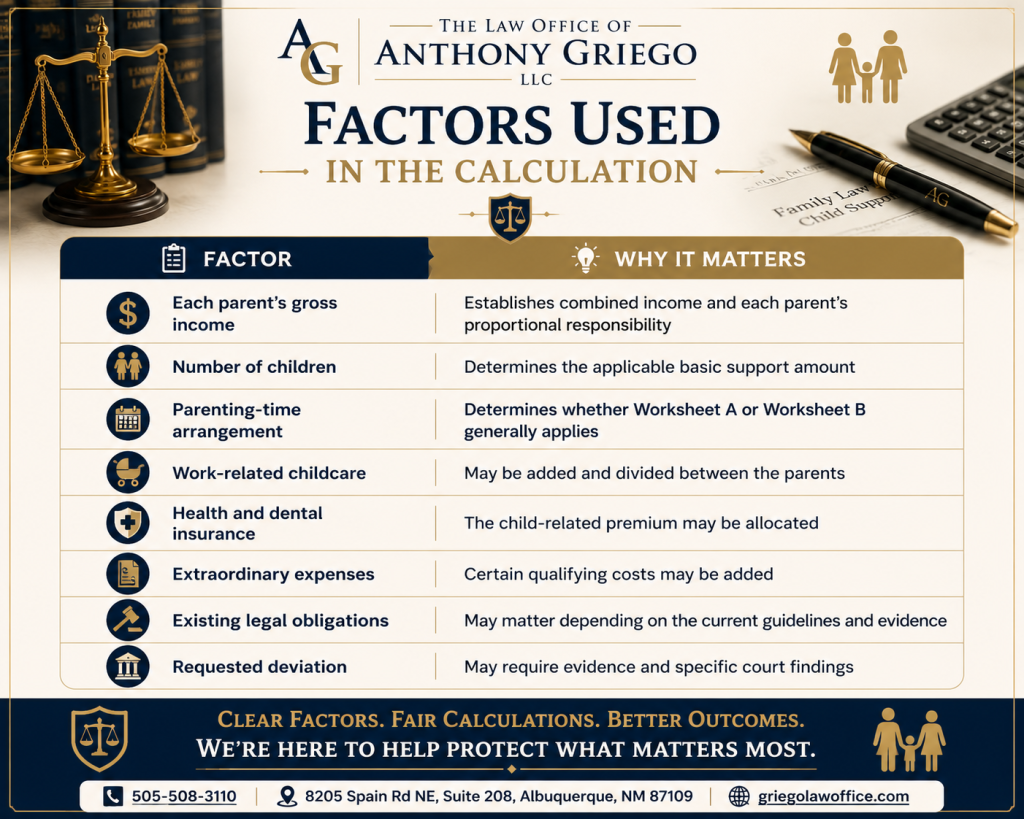
New Mexico courts apply statutory child-support guidelines when establishing or modifying child support. The court calculates a presumptive obligation using the parents’ financial information, the applicable worksheet, and the state’s current basic child-support schedule.
In an Albuquerque divorce involving minor children, the parents ordinarily must complete a child-support worksheet and submit it with the final documents presented to the judge. The Second Judicial District Court explains that once the timesharing schedule is known, the support amount can be calculated under the guidelines and that the worksheet must accompany the final papers.
The basic process usually involves:
- Determining each parent’s gross monthly income.
- Combining the parents’ income.
- Identifying the number of children covered by the order.
- Determining the parenting-time arrangement.
- Selecting Worksheet A or Worksheet B.
- Calculating the basic support obligation.
- Adding or allocating qualifying childcare, insurance, and extraordinary expenses.
- Determining the presumptive amount one parent will transfer to the other.
- Submitting the calculation for court review.
The worksheet is an important part of the process, but it is not the final court order by itself. The judge must review and approve the child-support obligation.
What Income Does the Court Consider?
The calculation begins with each parent’s gross income as defined by New Mexico law.
Depending on the facts of the case, income may include earnings such as:
- Wages
- Salary
- Commissions
- Bonuses
- Overtime
- Self-employment income
- Business income
- Certain benefits
- Other recurring sources of income
The precise treatment of a payment can depend on its source, regularity, and the current statutory definition. A parent should not assume that taxable income shown on one line of a tax return will always be identical to income used for child-support purposes.
Why gross income can become disputed
For a salaried employee with consistent pay, identifying monthly income may be relatively straightforward. The calculation can become more difficult when a parent:
- Is self-employed
- Owns a closely held business
- Works for cash
- Receives irregular commissions
- Earns seasonal income
- Regularly works overtime
- Receives substantial bonuses
- Has recently changed jobs
- Is voluntarily working fewer hours
- Has personal expenses paid through a business
- Claims business deductions that do not reduce available cash in the same way
In these cases, tax returns may be only the beginning of the financial review. Pay records, bank statements, profit-and-loss reports, business ledgers, 1099 forms, corporate records, and evidence of recurring benefits may also become relevant.
The goal is to use accurate financial information rather than an unsupported estimate offered by either parent.
Both Parents’ Incomes Affect the Calculation
New Mexico’s basic child-support obligation is calculated from the parents’ combined income and divided proportionately between them.
For example, if one parent earns 60% of the parents’ combined gross income and the other earns 40%, those percentages generally influence how the basic obligation and qualifying additional expenses are allocated.
This does not mean the higher-earning parent automatically pays a fixed amount in every case. The final transfer also depends on factors such as:
- Which worksheet applies
- How much parenting time each parent has
- Which parent pays the children’s insurance premium
- Which parent pays qualifying childcare
- Whether extraordinary expenses are included
- Whether a legally supported adjustment is appropriate
Both parents are financially responsible for their children, even when only one parent ultimately makes a monthly payment to the other.
How Parenting Time Affects Child Support
Parenting time is one of the most important parts of the New Mexico child-support calculation because it helps determine which worksheet applies.
New Mexico distinguishes generally between:
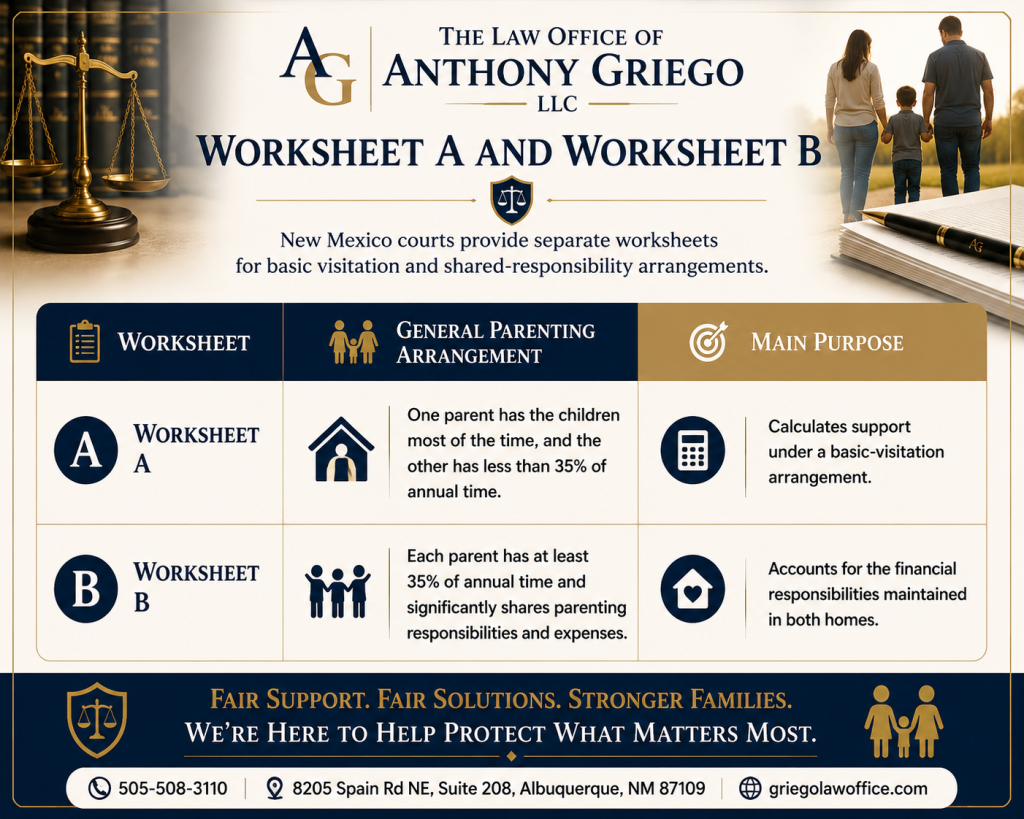
- Basic visitation, where one parent has the children most of the time and the other has them less than 35% of the year
- Shared responsibility, where the children spend at least 35% of the year in each parent’s home and the parents significantly share parenting duties, responsibilities, and expenses
Thirty-five percent of a year is approximately 128 twenty-four-hour days. The actual calculation should be based on the parenting plan and the number of qualifying twenty-four-hour periods—not a casual estimate that the arrangement feels “close to equal.”
Legal custody and physical timesharing should also be kept separate. Parents may share legal custody and decision-making even when the children spend substantially more time in one home. Shared legal custody alone does not automatically require Worksheet B.
Likewise, equal or nearly equal parenting time does not necessarily mean neither parent will pay child support. Differences in income, insurance costs, childcare, and other expenses may still create a payment obligation.
Worksheet A and Worksheet B
New Mexico courts provide separate worksheets for basic visitation and shared-responsibility arrangements.
How Worksheet A generally operates
Under Worksheet A, the calculation generally:
- Combines both parents’ monthly income.
- Uses the state schedule to identify the basic obligation for the number of children.
- Determines each parent’s percentage of combined income.
- Allocates the basic obligation proportionately.
- Adds or adjusts qualifying insurance, childcare, and other expenses.
- Determines the amount transferred between the parents.
How Worksheet B generally operates
Worksheet B uses a more detailed shared-responsibility calculation.
Under the statutory worksheet instructions, the basic obligation is adjusted for maintaining children in two homes. Each parent’s share is then affected by that parent’s percentage of income and percentage of annual twenty-four-hour days with the children. The calculation recognizes that both parents directly pay expenses during their parenting time.
The parent with more parenting time is not automatically the parent who receives support. In a shared arrangement, the income difference between the parents may have a substantial effect on the final amount.
Childcare and Health-Insurance Costs
The guideline amount is not always limited to the basic obligation shown on the support schedule.
New Mexico law provides that the cost of medical and dental insurance for the children and net reasonable childcare costs incurred because of a parent’s employment or job search are generally paid proportionately based on the parents’ incomes, in addition to the basic obligation.
Work-related childcare
Qualifying childcare may include care needed so a parent can:
- Work
- Maintain employment
- Search for employment
The amount should be supported with reliable documentation, such as invoices, receipts, provider statements, or payment records.
Not every babysitting or childcare expense will necessarily qualify. The connection between the expense and employment or job searching can matter.
Medical and dental insurance
The calculation may also credit or allocate the cost of providing medical and dental insurance for the children.
When a parent’s insurance covers the entire household, the relevant figure is generally the amount attributable to covering the children—not necessarily the full family premium.
Documentation may include:
- Employer benefit statements
- Insurance rate sheets
- Payroll deductions
- A comparison between employee-only and family coverage
- Statements showing the additional cost of covering the children
Extraordinary Expenses
New Mexico law also allows certain expenses outside the basic obligation to be considered. These may include:
- Extraordinary uninsured medical, dental, or counseling expenses
- Extraordinary educational expenses
- Transportation and communication costs necessary for long-distance visitation or time sharing
Whether an expense qualifies can depend on the nature of the cost, available documentation, the child’s needs, and the circumstances of the parents.
Parents should not assume that every extracurricular activity, private-school tuition payment, medical bill, or travel expense will automatically be added. Disputed expenses may require evidence and legal argument.
What Happens When Income Is Disputed?
Income disputes are common in contested divorce and child-support proceedings.
Self-employment income
A self-employed parent may report relatively low taxable income while receiving other economic benefits through the business. A meaningful review may require examining:
- Gross business receipts
- Ordinary and necessary business expenses
- Personal expenses paid by the company
- Vehicle use
- Housing or travel expenses
- Cash transactions
- Owner distributions
- Depreciation
- Retained earnings
- Loans from the business
- Changes in revenue around the time of divorce
The purpose is not to assume wrongdoing. It is to distinguish legitimate operating expenses from payments or benefits that may reflect income available to the parent.
Bonuses, overtime, and commissions
Variable compensation can also create disagreements. Questions may include:
- Is the payment recurring?
- Is it discretionary?
- Does the parent receive it most years?
- Is overtime required or voluntary?
- Is the current year unusually high or low?
- Should income be averaged over several years?
The answer can depend heavily on the evidence.
Reduced or missing income
A parent cannot safely assume that voluntarily reducing income will automatically reduce the support obligation. When unemployment, underemployment, or a sudden income decline is disputed, the court may examine why the change occurred and whether the claimed income accurately represents the parent’s earning circumstances.
Because these questions are fact-sensitive, an article or online calculator cannot predict how they will be resolved in a particular case.
Can a Judge Order a Different Amount?
The New Mexico child-support guidelines create a presumptive amount, but the result is rebuttable rather than completely inflexible.
A court may consider a different amount when applying the guidelines would be unjust, inappropriate, or create substantial hardship. The reason for departing from the presumptive calculation generally must be supported by evidence and reflected in the court’s findings.
One statutory hardship issue arises when a single current child-support obligation would require a person to pay more than 40% of that person’s gross income. The statute creates a presumption of substantial hardship in that circumstance.
A request to depart from the guidelines should not be treated as an informal appeal to fairness. The parent requesting a different amount should be prepared to explain the legal and factual basis for it.
Why an Online Calculator Is Only an Estimate
The New Mexico Courts provide child-support resources, forms, and calculation tools.
A calculator can be helpful for preliminary planning, but it is not legally binding. Its result depends entirely on the information entered.
An estimate can be inaccurate when:
- The wrong worksheet is selected.
- Income is incomplete.
- Monthly and annual figures are confused.
- Gross and net income are mixed.
- Bonuses or commissions are omitted.
- Self-employment income is entered incorrectly.
- The parenting schedule is estimated inaccurately.
- The full family insurance premium is entered instead of the child-related cost.
- Childcare costs are unsupported or entered incorrectly.
- Extraordinary expenses are misunderstood.
- The calculator uses an outdated schedule.
The court enters the final order. An online calculation does not replace verified financial disclosure, legal analysis, or judicial review.
Documents to Gather Before Calculating Support
Parents can make the process more efficient by collecting accurate records early.
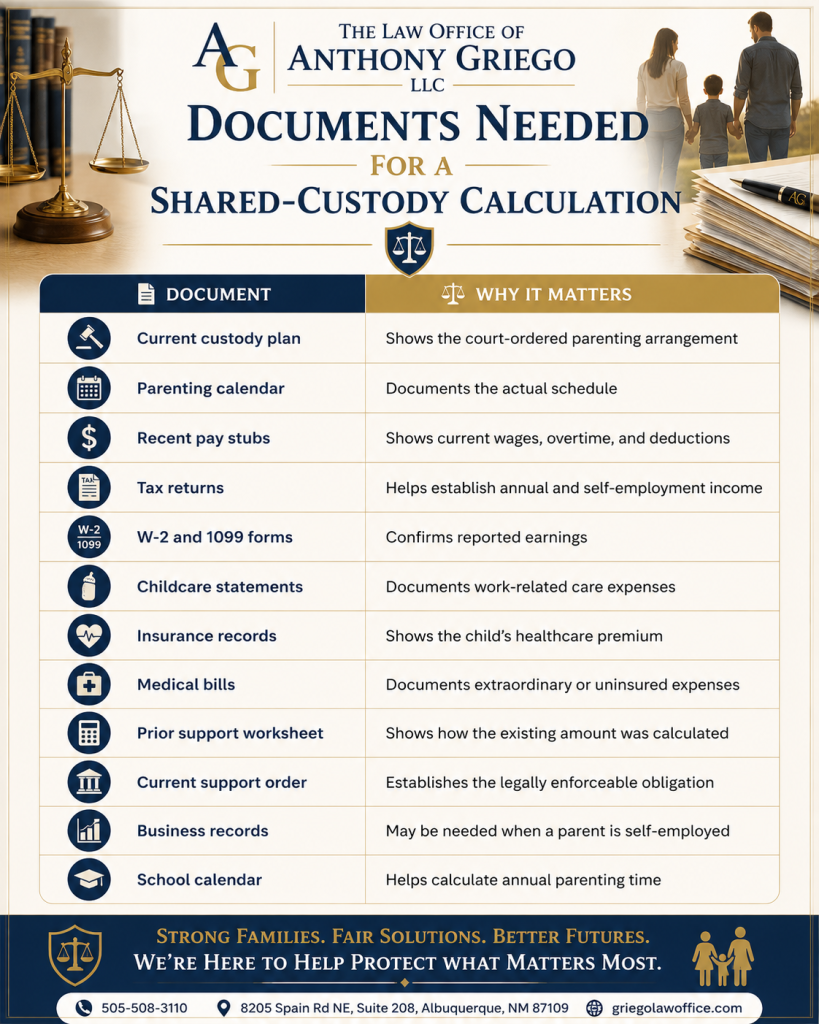
Producing complete records can reduce unnecessary disputes. Hiding, minimizing, or estimating income without documentation usually makes the process more difficult.
Common Mistakes During a New Mexico Divorce
Using take-home pay instead of the required income figure
Child support generally begins with gross income, not simply the amount deposited after taxes, insurance, retirement contributions, and other deductions.
Assuming equal custody eliminates support
A shared schedule does not guarantee a zero-dollar order. Income and expenses still matter.
Estimating parenting time loosely
The distinction between Worksheet A and Worksheet B can depend on actual twenty-four-hour days under the parenting plan.
Entering the full family insurance premium
The calculation may require identifying the amount attributable to the children rather than the entire household premium.
Ignoring variable income
Bonuses, commissions, overtime, or business distributions may materially change the calculation.
Failing to document childcare
Unsupported estimates may not carry the same weight as invoices, contracts, receipts, or provider statements.
Treating the calculator result as final
The worksheet is a tool. It does not resolve disputed facts or replace the judge’s order.
Agreeing without understanding the calculation
Even in an uncontested divorce, both parents should understand the income figures, worksheet, parenting schedule, and expense allocations used in the proposed order.
Frequently Asked Questions
Does the court consider both parents’ incomes?
Yes. The basic child-support obligation is calculated using the parents’ combined income and is generally divided proportionately.
Does equal parenting time mean no child support?
No. Differences in income, insurance, childcare, and other expenses can still result in one parent paying support.
What is the difference between Worksheet A and Worksheet B?
Worksheet A generally applies to basic-visitation arrangements. Worksheet B generally applies when each parent has at least 35% of annual parenting time and significantly shares parenting responsibilities and expenses.
Are childcare costs included?
Net reasonable childcare expenses connected to employment or job searching may be added and divided proportionately between the parents.
Who receives credit for health insurance?
The parent paying for the children’s medical or dental insurance may receive an adjustment or credit through the worksheet. The child-related cost should be documented.
Can the court use a different amount from the worksheet?
Yes, in appropriate circumstances. A departure from the presumptive amount generally requires a legally supported reason and court findings.
Is the New Mexico child-support calculator binding?
No. It provides an estimate based on the information entered. The final obligation is established by court order.
Can child support be changed after the divorce?
A parent may request modification after an order has been entered. Whether a change will be granted depends on New Mexico law, the new financial information,
When Should You Speak with a Child Support Attorney?
Although New Mexico’s Child Support Guidelines provide a standardized method for calculating child support, every family’s financial and parenting circumstances are different. Even cases that appear straightforward can become more complicated when questions arise about income, self-employment, parenting schedules, childcare expenses, health insurance, or requests to modify an existing support order.
Speaking with an experienced family law attorney early in the process can help you better understand your legal rights and responsibilities before important decisions are made.
You may benefit from legal guidance if:
- You are beginning a divorce involving minor children.
- You and the other parent disagree about each parent’s income.
- One parent is self-employed or owns a business.
- Parenting time is disputed.
- You believe the proposed child support amount is inaccurate.
- You need to establish child support for the first time.
- You are requesting a modification because circumstances have changed.
- Your former spouse has experienced a significant increase or decrease in income.
- Child support enforcement has become necessary.
- You have questions about your obligations under an existing court order.
An attorney can explain how New Mexico law applies to your particular situation, review financial documentation, identify potential issues before they become larger problems, and help ensure that the appropriate legal procedures are followed throughout your case.
Why Experienced Legal Representation Matters
Child support decisions often affect families for many years after a divorce is finalized. While the calculation itself follows statutory guidelines, gathering accurate financial information, presenting evidence, and addressing disputes can require careful preparation.
The Law Office of Anthony Griego LLC assists clients throughout New Mexico with a wide range of family law matters, including:
- Divorce
- Child Support
- Child Custody
- Parenting Plans
- Child Support Modifications
- Child Support Enforcement
- Contested Divorce
- Uncontested Divorce
- Family Law Litigation
Anthony Griego brings years of experience representing clients in New Mexico family courts. Every family is different, and every case deserves an individualized approach that focuses on protecting both parental rights and the best interests of the children involved.
Whether your situation involves establishing an initial child support order or resolving disagreements over an existing order, experienced legal guidance can help you better understand the process and make informed decisions.
Contact The Law Office of Anthony Griego LLC
If you have questions about how child support is calculated in New Mexico or need assistance with a divorce involving children, The Law Office of Anthony Griego LLC is here to help.
Whether you are concerned about income calculations, shared custody arrangements, childcare expenses, health insurance, or modifying an existing support order, obtaining legal advice early can often help avoid unnecessary delays and costly mistakes.
The Law Office of Anthony Griego LLC
8205 Spain Road NE, Suite 208
Albuquerque, NM 87109
Phone: 505-508-3110
Contact The Law Office of Anthony Griego LLC today to schedule a confidential consultation and learn how New Mexico’s child support laws may apply to your family’s unique circumstances.