
Many parents assume that once a divorce is finalized, every part of the divorce decree—including child support—is permanently set in stone. In reality, that is not how New Mexico family law works. While a finalized divorce establishes legally enforceable obligations, child support orders can often be modified when circumstances change in a meaningful way.
Life rarely remains the same after a divorce. A parent may lose a job, receive a significant promotion, change careers, experience health problems, or begin exercising substantially more parenting time with a child. Likewise, children grow older, their educational and medical needs evolve, childcare costs fluctuate, and unexpected financial situations can arise. When these types of changes occur, the original child support order may no longer accurately reflect the family’s current circumstances.
However, modifying child support is not automatic. New Mexico courts generally require a legally sufficient reason before changing an existing child support order. A parent cannot simply decide to pay less—or request more support—because circumstances have changed. Instead, the court must determine whether the facts justify modifying the existing order under New Mexico law.
Understanding when child support may be modified is important for both parents who pay support and parents who receive it. Acting too quickly without legal guidance can create unnecessary financial and legal problems, while waiting too long to request a modification may cause avoidable hardship.
At The Law Office of Anthony Griego LLC, Attorney Anthony Griego helps parents throughout Albuquerque and Central New Mexico navigate child support matters with practical legal guidance and experienced courtroom representation. As a former Assistant District Attorney with extensive family law experience, he understands how New Mexico courts evaluate post-divorce modifications and works closely with clients to protect their parental rights and their children’s best interests.
New Mexico Uses Child Support Guidelines
New Mexico uses statutory child support guidelines to help determine the amount of financial support a child should receive from each parent. These guidelines are designed to promote fairness and consistency by considering numerous financial factors rather than relying on arbitrary numbers.
Although every family’s situation is unique, courts commonly evaluate factors such as:
- Each parent’s gross income
- Parenting time and custody arrangements
- Health insurance costs for the child
- Work-related childcare expenses
- Other allowable adjustments under New Mexico law
The purpose of these guidelines is to ensure that children continue to receive appropriate financial support after their parents separate or divorce. Child support is intended to help meet a child’s ongoing needs, including housing, food, clothing, education, healthcare, and other ordinary expenses.
Importantly, the child support amount established during a divorce reflects the circumstances that existed when the order was entered. If those circumstances later change significantly, the original calculation may no longer produce an appropriate result.
This is why New Mexico law allows courts to review and, when appropriate, modify existing child support orders instead of treating them as permanent regardless of changing circumstances.
What Does It Mean to Modify Child Support?
A child support modification is a legal request asking the court to change an existing child support order. Depending on the facts of the case, the court may increase, decrease, or otherwise adjust the amount of support that must be paid.
Modification is not the same as establishing child support for the first time or enforcing unpaid support. These are separate legal proceedings with different legal standards.
For example:
- Establishing child support creates the original support obligation during a divorce or parentage case.
- Enforcing child support focuses on collecting payments when a parent has failed to comply with an existing court order.
- Modifying child support asks the court to update an existing order because circumstances have materially changed since it was entered.
Parents sometimes believe they can simply agree between themselves to reduce or eliminate child support payments. While cooperative parenting is often beneficial, informal agreements generally do not change the legal obligation established by a court order. Until a judge approves a modification, the existing order typically remains fully enforceable.
Because of this, it is important to seek legal guidance before changing payment amounts or relying on verbal agreements, even if both parents initially agree with the proposed changes.
Common Reasons Parents Request Modification
Every family’s situation is different, but certain circumstances commonly lead parents to ask the court to review an existing child support order.\
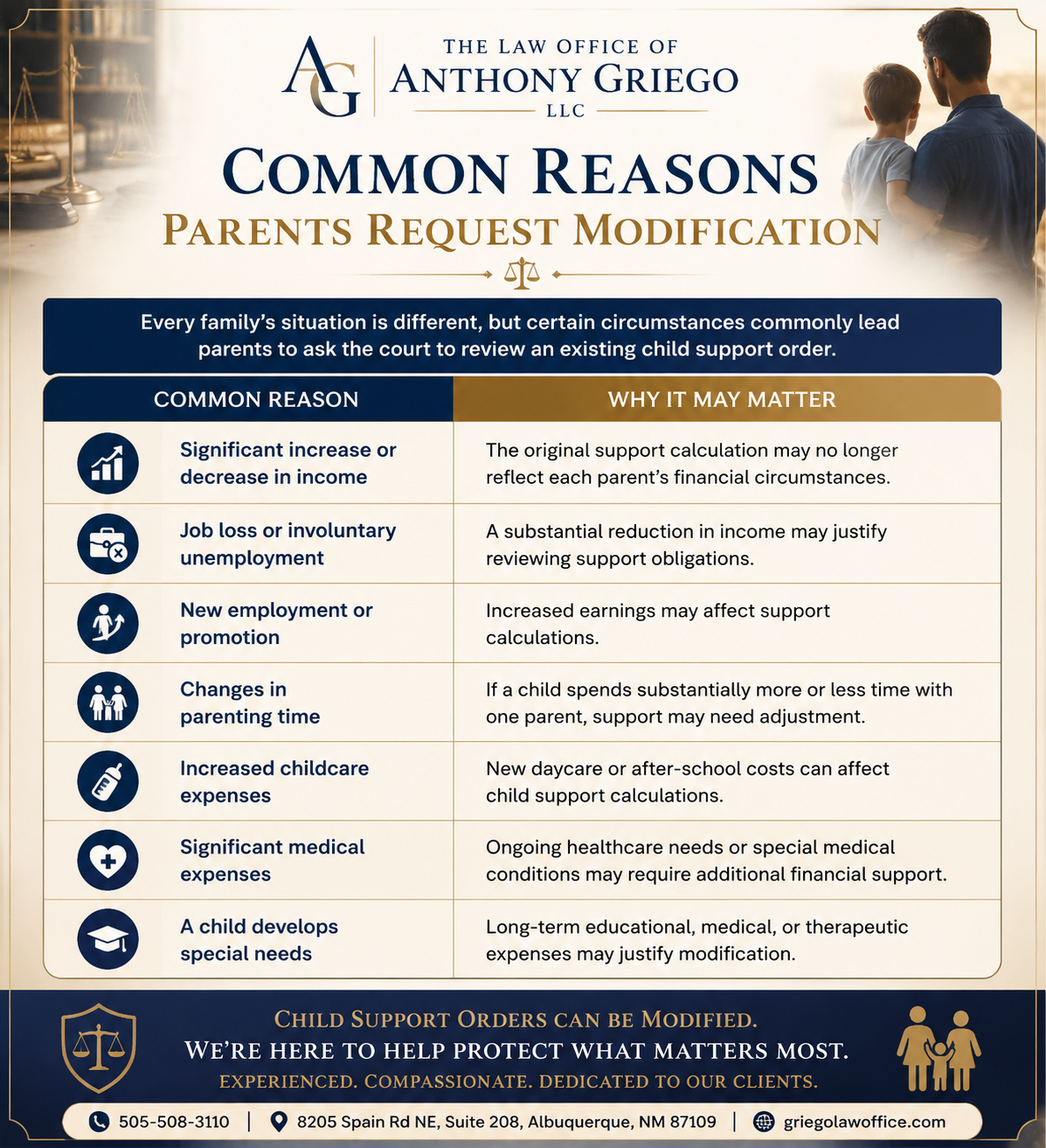
Not every financial change automatically qualifies for a modification. Courts generally look for a substantial change in circumstances and evaluate the specific facts presented. Temporary fluctuations in income or voluntary employment decisions may not justify modifying an existing order.
Understanding whether your circumstances are likely to meet New Mexico’s legal standard is often one of the most important reasons to consult with an experienced family law attorney before filing a request.
What Is a “Substantial Change in Circumstances”?
New Mexico courts may modify an existing child support obligation when a parent shows that material and substantial changes have occurred since the previous order was entered. The change must be meaningful enough to justify recalculating support; a minor or temporary financial fluctuation may not be sufficient.
New Mexico law creates a rebuttable presumption that a material and substantial change has occurred when:
- Applying the current child support guidelines would increase or decrease the existing obligation by more than 20%; and
- The request for modification is filed more than one year after the previous order was filed.
The 20% rule does not mean that every parent must wait one year before asking for a modification or that no other circumstances can justify a change. It establishes a legal presumption when both requirements are met. Other significant changes may still require individual review by the court.
Changes in Income
A substantial change in either parent’s income is one of the most common reasons for seeking a New Mexico child support modification.
Because the state guidelines consider both parents’ income, a meaningful increase or decrease in earnings may change the amount produced by the current worksheet. Examples may include:
- A substantial raise or promotion
- A significant reduction in work hours
- Loss of recurring commissions or bonuses
- A career change
- Disability or serious illness
- Retirement
- A major change in business income
The court will generally need reliable evidence showing what changed and whether the change is likely to continue. One unusually high paycheck or a brief reduction in hours may not accurately represent a parent’s ongoing financial circumstances.
Job Loss
Losing a job may support a request to decrease child support, but job loss does not automatically change the existing order. Until the court enters a modified order, the current payment obligation generally remains in effect.
The court may consider:
- Whether the job loss was voluntary or involuntary
- The parent’s previous income
- Efforts to find comparable employment
- Unemployment benefits
- Severance pay
- Other available income
- The length of the unemployment
- The parent’s education, experience, and earning capacity
A parent who has been laid off should keep records of termination notices, unemployment benefits, applications, interviews, and job-search efforts. Waiting while unpaid support accumulates can make the situation considerably more difficult.
New Employment
New employment can affect child support when it materially changes a parent’s income. This may involve a higher salary, lower salary, different benefits, commissions, overtime, or a new work schedule.
A parent seeking modification should provide complete information rather than relying only on the stated hourly wage or annual salary. Relevant documents may include:
- Employment offer letters
- Recent pay stubs
- Bonus or commission plans
- Benefits statements
- Work schedules
- Tax withholding records
If the new position includes variable compensation, the court may need additional evidence before deciding what income figure fairly reflects the parent’s circumstances.
Self-Employment
Self-employment often makes child support modification more complicated because taxable business income may not tell the entire story.
A court may need to examine:
- Business revenue
- Ordinary and necessary business expenses
- Owner draws or distributions
- Cash payments
- Personal expenses paid by the business
- Company vehicles or housing benefits
- Profit-and-loss statements
- Bank records
- Tax returns
A recent decline in business revenue does not always mean that the parent’s available income has fallen by the same amount. Likewise, legitimate business expenses should not be treated automatically as personal income. Careful financial documentation is essential.
Parenting-Time Changes
A meaningful change in the parenting schedule may affect which New Mexico child support worksheet applies or how the current obligation is calculated.
For example, modification may be appropriate when a child begins spending substantially more time in one parent’s home or when the parents move from a basic-visitation arrangement to shared responsibility. Parenting-time changes should be reflected in an updated parenting plan and supported by the actual schedule, not merely an informal understanding.
Changing child support does not automatically modify custody, and changing custody does not automatically modify support. Each issue may require a separate court request.
Changes in Childcare Expenses
Work-related childcare expenses may affect the support calculation. A modification request may arise when:
- A child starts or leaves daycare
- Before-school or after-school care begins
- Childcare rates increase substantially
- A parent’s work schedule changes
- Childcare is no longer necessary
Parents should retain invoices, contracts, receipts, and payment records. The court may also consider whether the expense is reasonable and connected to employment or a job search.
Medical Needs
New Mexico’s modification statute specifically recognizes changes involving a child’s healthcare needs and the availability of healthcare coverage.
A modification may be requested when:
- Insurance coverage changes
- Premiums increase or decrease
- A child develops an ongoing medical condition
- Significant uninsured expenses arise
- One parent becomes able to provide better or more affordable coverage
Medical records, insurance statements, premium information, and expense documentation may be needed.
Special Needs of the Child
A child’s newly identified physical, developmental, educational, behavioral, or therapeutic needs may substantially change the family’s expenses.
Relevant costs may involve:
- Specialized medical care
- Counseling or therapy
- Educational evaluations
- Adaptive equipment
- Specialized childcare
- Transportation
- Continuing treatment
The court will evaluate the child’s actual needs, the evidence supporting the expenses, and each parent’s financial circumstances. A diagnosis alone does not establish the amount of a modification, but documented long-term needs may provide an important basis for reviewing the existing support order.
How the Modification Process Works in New Mexico
A parent seeking to modify child support generally must ask the court that entered the existing order to review it. The process is not automatic, even when both parents agree that the current amount should change.
In Albuquerque and Bernalillo County, the Second Judicial District Court provides forms for filing a motion to modify or enforce child support. The court also requires a completed child-support worksheet when a parent asks to modify the existing obligation.
The process commonly includes the following steps:
- Review the current child support order.
- Calculate the possible new amount under the current guidelines.
- Gather evidence showing the changed circumstances.
- File the appropriate motion and supporting documents.
- Provide proper notice or service to the other parent.
- Allow the other parent an opportunity to respond.
- Attend a hearing if the matter is disputed.
- Obtain a signed modification order from the court.
The New Mexico Courts provide a motion-to-modify form that may be used to request changes to a final order, including a child support obligation.
If the parents agree, they may be able to submit a written stipulation and proposed order for court approval. If they disagree, the judge or hearing officer may review testimony, financial records, parenting schedules, and other evidence before deciding whether modification is appropriate.
Documents You’ll Need
A successful request usually depends on current, organized documentation. The court needs reliable information to compare the circumstances that existed when the original order was entered with the circumstances that exist now.
Helpful documents may include:
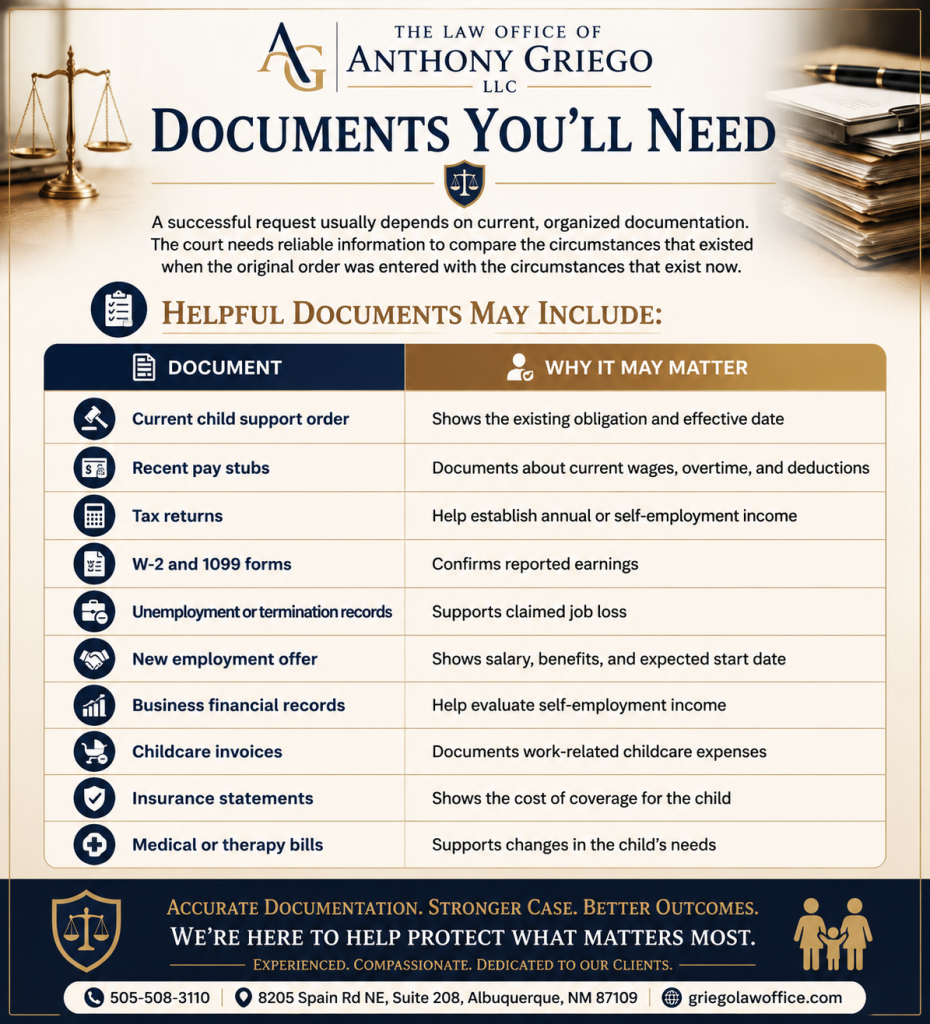
A parent should avoid relying only on verbal explanations. Courts generally make better-informed decisions when claims are supported by complete records.
Why Parents Should Never Make Informal Agreements
Parents sometimes agree privately to reduce, suspend, or stop child support. One parent may lose a job, the child may begin living primarily with the other parent, or both parents may believe the existing amount no longer makes sense.
Even when the agreement is cooperative and reasonable, it may not change the court order.
Until a judge signs a modification, the original obligation may remain enforceable. This can create serious problems. A parent who pays less under a verbal agreement may later be accused of owing arrears. The receiving parent may also face difficulty enforcing the new arrangement because it was never approved by the court.
A private agreement also may not address:
- The effective date of the change
- Unpaid support
- Income withholding
- Medical support
- Childcare expenses
- Future parenting-time changes
- Whether the modification complies with current guidelines
The safest approach is to put the agreement in writing and submit it to the court for approval.
Common Mistakes to Avoid
Stopping Payments Before Filing
A job loss or parenting change does not automatically suspend the existing order.
Waiting Too Long
A parent who delays seeking modification may continue accumulating obligations under the current order.
Filing Without a New Worksheet
The Second Judicial District Court states that a child-support worksheet must be completed when requesting modification.
Using Incomplete Income Information
Leaving out bonuses, commissions, business income, or recurring benefits can undermine credibility and produce an inaccurate calculation.
Confusing Custody with Child Support
Changing parenting time may affect support, but a support modification does not automatically change the custody plan.
Treating Modification as Enforcement
Modification changes future obligations. Enforcement addresses unpaid amounts or violations of an existing order.
Frequently Asked Questions
Can parents agree to modify child support without a hearing?
They may reach an agreement, but the change should be submitted to the court and incorporated into a signed order before either parent relies on it.
How often can child support be modified?
There is no simple universal limit, but each request must have a legally sufficient basis. Repeated filings without meaningful new circumstances may not succeed.
Does remarriage automatically change child support?
No. Remarriage alone does not automatically modify the order, although related financial circumstances may require closer legal analysis.
Does having another child reduce child support?
Not automatically. The court must apply current law and evaluate the parent’s financial obligations and the facts of the case.
How long does a modification case take?
Timing varies based on court schedules, service, financial disclosure, whether the other parent objects, and whether a hearing is necessary.
Can a modification erase unpaid support?
A modification request generally addresses the ongoing obligation. Past-due support raises separate enforcement and arrears issues that should be reviewed carefully.
When to Speak with an Attorney
Not every change in a parent’s circumstances will justify modifying child support. The legal standard, supporting documents, timing of the request, and accuracy of the proposed calculation can all affect the outcome.
Consider speaking with a New Mexico family law attorney when:
- Your income has increased or decreased significantly.
- You have lost your job or become unable to work.
- The other parent’s income appears to have changed substantially.
- You or the other parent is self-employed.
- Your parenting-time arrangement has changed.
- Your child’s medical, educational, or therapeutic needs have increased.
- Work-related childcare expenses have changed.
- You believe the current order was based on inaccurate information.
- The other parent is requesting a modification.
- You and the other parent have reached an informal agreement.
- Unpaid support has accumulated.
- You are unsure whether to seek modification or enforcement.
An attorney can review the existing order, compare the original calculation with current circumstances, help identify the correct court forms, evaluate financial records, and prepare the evidence needed to support or oppose a requested modification.
Legal guidance can be particularly important when income is disputed. Self-employment, commissions, bonuses, overtime, business-paid expenses, unemployment, retirement, and voluntary reductions in earnings can make the calculation more complicated than entering numbers into an online worksheet.
Speak With an Albuquerque Child Support Modification Attorney
Child support orders are intended to reflect a family’s financial and parenting circumstances, but those circumstances can change after a divorce. A parent may lose employment, begin earning substantially more, take on a different parenting schedule, or face new expenses connected to a child’s health, education, or care.
When that happens, continuing under an outdated order may create hardship for one parent or fail to account for the child’s current needs. At the same time, reducing or stopping payments without court approval can lead to arrears, enforcement proceedings, and additional legal complications.
The Law Office of Anthony Griego LLC assists parents with modifying child support, child support enforcement, parenting-plan disputes, custody modifications, and other post-divorce family law matters. Anthony Griego provides direct attorney involvement, practical guidance, and experienced courtroom representation for clients throughout Albuquerque and Central New Mexico.
Before changing payments or relying on an informal agreement, obtain advice based on your actual order and present circumstances.
Contact The Law Office of Anthony Griego LLC at 505-508-3110 to schedule a confidential family law consultation.
The Law Office of Anthony Griego LLC
8205 Spain Rd. NE, Suite 208
Albuquerque, New Mexico 87109
Phone: 505-508-3110