
When your former spouse or co-parent stops paying court-ordered child support, the effects can be immediate. Rent, groceries, school expenses, childcare, healthcare, and other everyday costs do not stop simply because a payment is late.
You may feel angry, frightened, or uncertain about what to do next. You may also wonder whether you should confront the other parent, withhold visitation, call the police, or return to court.
In New Mexico, a child support order is legally enforceable. The parent who was ordered to pay generally cannot reduce, suspend, or stop payments without obtaining a new court order. A job loss, disagreement over parenting time, or change in personal circumstances does not automatically cancel the existing obligation.
When payments stop, the parent who is owed support may be able to seek enforcement through the court or request assistance through New Mexico’s Child Support Services Division. Potential remedies can include income withholding, tax-refund interception, liens, civil contempt, and other collection measures, depending on the circumstances.
The right response depends on the wording of the existing order, the payment history, the amount owed, and whether a government child-support case is already open. Acting promptly can help preserve records, prevent confusion, and reduce the chance that unpaid support continues to accumulate without a formal response.
The Child Support Order Remains in Effect
A New Mexico child support order remains controlling until it expires under the law or is changed by the court.
The paying parent cannot independently decide that the amount is unfair, unaffordable, or no longer necessary. Even if that parent has lost a job, taken a lower-paying position, become ill, or experienced another major financial change, the existing payment generally remains due unless a court approves a child support modification.
This distinction is important because modification and enforcement serve different purposes.
Modification asks the court to change the amount of ongoing support based on changed circumstances.
Enforcement asks the court or an enforcement agency to require compliance with an existing order and address unpaid amounts.
A parent who believes the current amount is no longer appropriate should request a modification rather than simply stop paying. Until a new order is entered, missed payments can become child support arrears.
What Are Child Support Arrears?
Child support arrears are payments that became due under a court order but were not paid in full.
For example, if a parent is ordered to pay $600 each month but pays only $300, the remaining $300 may become part of the arrears balance. If no payment is made, the full monthly obligation may be added to that balance.
Arrears can grow quickly when several payments are missed. New Mexico law also provides that interest accrues on delinquent child support at a rate of four percent from the date the payment becomes delinquent until it is paid. A consolidated judgment for delinquent child support also accrues interest at four percent until the judgment is satisfied.
The receiving parent should keep careful records showing:
- The amount ordered
- The date each payment was due
- The amount actually received
- The date each payment was received
- Any partial payments
- Any payments made outside the official payment system
- Messages in which the other parent discusses payment
- Notices from an employer or child-support agency
- Records of returned or canceled payments
Do not rely entirely on memory. A complete payment history can be important when asking the court to determine how much remains unpaid.
What Should You Do When Child Support Payments Stop?
The first step is to review the current order and confirm exactly what it requires. Check the payment amount, due dates, payment method, income-withholding provisions, medical-support requirements, and any language addressing arrears.
Next, determine whether the payment is truly late or whether there may be an administrative delay. Payments sent through an employer or government system may not always appear immediately.
If the payment is late, document it. Save account statements, payment histories, emails, text messages, and any communication from the other parent.
A calm written inquiry may sometimes clarify whether the missed payment resulted from a payroll problem, employment change, or temporary processing issue. However, avoid threats, insults, public accusations, or agreements that contradict the court order.
If missed payments continue, speak with an experienced Albuquerque child support attorney about the available enforcement options. Depending on the case, it may be appropriate to file a motion to enforce, request an order to show cause, seek income withholding, or apply for state child-support services.
How Child Support Enforcement Works in New Mexico
A parent can generally pursue enforcement through the court that entered the existing child support order. The Second Judicial District Court provides forms for motions to modify or enforce child support in Albuquerque and Bernalillo County.
A typical court enforcement process may include:
- Reviewing the existing order
- Calculating the unpaid balance
- Gathering payment records and financial documents
- Filing the appropriate motion
- Providing notice to the other parent
- Requesting a hearing
- Presenting evidence of the missed payments
- Allowing the other parent to respond
- Obtaining an enforcement order from the court
The precise procedure can vary according to the court, case history, and relief requested. A judge or child support hearing officer may examine the order, payment records, testimony, employment information, and the paying parent’s explanation before deciding what action is appropriate.
New Mexico Courts also maintains forms involving child support enforcement and wage withholding. A wage-withholding order directs an employer to hold money from a parent’s income for child support.
Common Child Support Enforcement Options
The remedy used in a particular case depends on factors such as the amount owed, the paying parent’s employment, prior violations, available assets, and whether Child Support Services is involved.
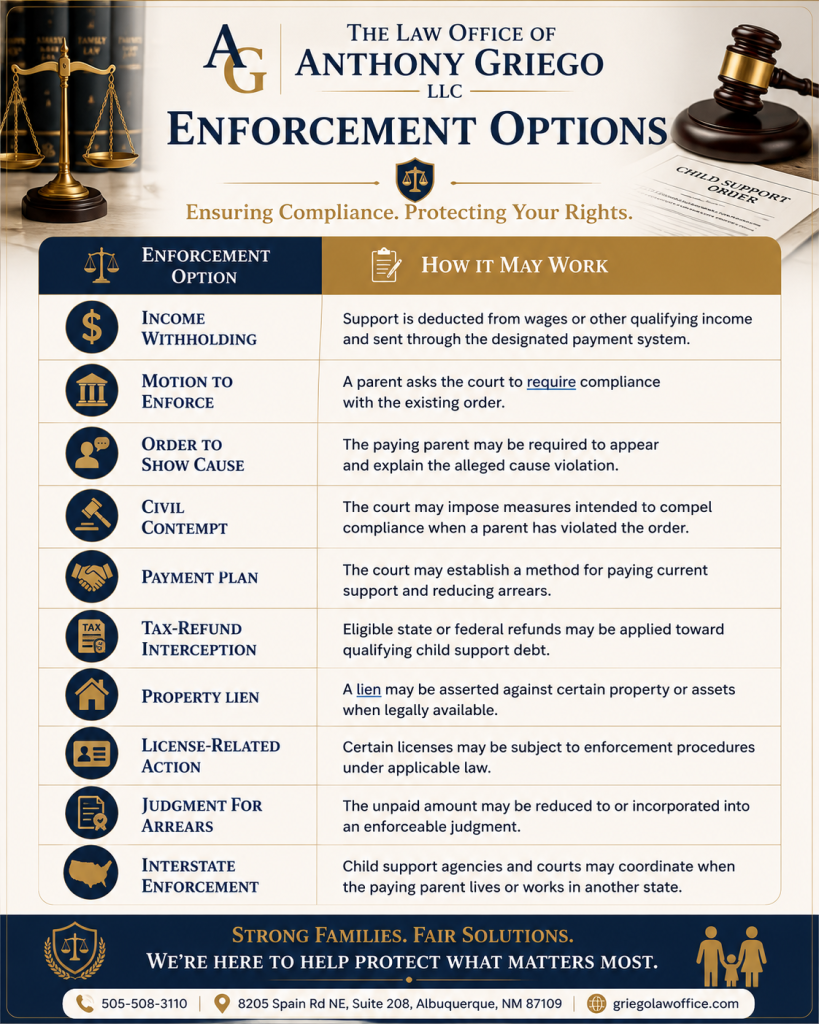
Not every option applies in every case. Some remedies require agency involvement, additional notice, a minimum arrears balance, or specific findings by the court.
Income Withholding and Wage Garnishment
Income withholding is one of the most common and effective methods of collecting child support.
A wage-withholding order directs the paying parent’s employer to deduct support from income and forward it through the required payment channel. New Mexico’s official child-support materials describe wage withholding as a particularly effective enforcement tool because it collects support directly from the income source and creates a clearer payment record.
Income withholding may help when the paying parent:
- Has a regular employer
- Frequently pays late
- Makes only partial payments
- Has accumulated arrears
- Changes jobs without arranging continued payment
- Claims that payments were made but lacks documentation
Wage withholding is not necessarily a punishment. It can provide consistency for the child and create an organized record for both parents.
However, withholding may be less straightforward when the paying parent is self-employed, paid in cash, working irregular jobs, or concealing employment.
What If My Ex Changes Jobs?
A job change does not erase the child support obligation.
When a parent leaves an employer, an existing withholding arrangement may be interrupted. The parent still remains responsible for making required payments while any new withholding order is processed.
Keep records if you learn that your ex has:
- Started a new job
- Left an employer
- Begun working as an independent contractor
- Opened a business
- Moved to another state
- Begun receiving unemployment or other income
- Failed to report updated employment information
An attorney or Child Support Services may be able to help identify the proper procedure for directing withholding to a new employer.
What If My Ex Is Self-Employed or Paid in Cash?
Self-employment can make collection more difficult, but it does not make a child support order unenforceable.
A self-employed parent may control business revenue, deductions, owner distributions, and the timing of payments. Income may come through multiple accounts or appear lower on a personal paycheck than the amount actually available to the parent.
Relevant evidence may include:
- Personal and business tax returns
- Bank statements
- Profit-and-loss statements
- Payment-platform records
- Business ownership documents
- Customer invoices
- Owner draws
- Business-paid personal expenses
- Property records
- Evidence of spending inconsistent with reported income
A court can review credible financial evidence rather than relying only on a parent’s statement that no income is available. Cases involving disputed self-employment income often benefit from careful discovery and legal analysis.
Can Tax Refunds Be Intercepted?
Tax-refund interception may be available in qualifying child support enforcement cases.
New Mexico’s official Child Support Services information identifies tax-refund interception as one of the potential remedies for enforcing unpaid child support. The New Mexico Taxation and Revenue Department also identifies the Child Support Enforcement Division among agencies involved in refund intercepts.
This does not mean every missed payment automatically causes a refund to be intercepted. Eligibility, notice, agency involvement, the amount owed, and applicable state or federal procedures can affect whether an intercept occurs.
Can Property Liens Be Used?
A child support enforcement agency may be able to place a lien against certain property or assets when the legal requirements are met.
A lien can affect a parent’s ability to sell, transfer, or refinance property without addressing the debt. The type of property involved, ownership records, existing liens, and procedural requirements can influence whether this remedy is useful.
Because liens involve technical notice, recording, and priority issues, parents should not attempt to create or enforce one without proper legal authority.
Can a Parent Be Held in Contempt?
A parent who violates a child support order may face civil contempt proceedings.
Contempt is not automatic merely because a payment was missed. The court will generally consider the existing order, the alleged violation, the amount owed, the parent’s ability to comply, the reasons for nonpayment, and other evidence.
The purpose of civil contempt is generally to compel compliance with the court’s order rather than simply punish a parent. New Mexico authority recognizes that imprisonment for failure to pay support rests within the trial court’s discretion and that contempt powers should be used cautiously.
Depending on the findings and applicable law, a court may order:
- Payment of a stated arrears amount
- A schedule for reducing arrears
- Continued current support
- Income withholding
- Reimbursement of certain costs
- Attorney fees where authorized
- Additional compliance conditions
- Other measures intended to enforce the order
In serious cases involving willful failure to comply despite an ability to pay, incarceration may be considered. However, it should never be presented as the guaranteed or immediate result of one missed payment.
Can My Ex Go to Jail for Not Paying Child Support?
Possibly, but jail is not automatic.
A court must consider the legal and factual circumstances. There is an important difference between a parent who has the ability to pay but intentionally refuses and a parent who genuinely cannot comply because of unemployment, disability, illness, or another significant hardship.
Even when a paying parent has experienced a legitimate financial setback, that parent should not ignore the order. The appropriate response is generally to request a formal modification and continue paying what can be paid while the request is pending, based on advice from legal counsel.
A parent facing contempt should take the matter seriously. Failure to appear at a properly scheduled hearing can create additional problems.
Can Professional or Driver’s Licenses Be Suspended?
License-related enforcement may be available in certain qualifying cases through child-support enforcement procedures.
The existence of this remedy does not mean a license is immediately suspended as soon as a payment is missed. Applicable thresholds, notices, opportunities to comply, administrative procedures, and the facts of the case may affect whether action is taken.
Because a license suspension can also interfere with a parent’s ability to work and pay support, these matters should be reviewed carefully.
Can You Deny Visitation When Child Support Is Not Paid?
You generally should not deny court-ordered parenting time solely because child support has not been paid.
Child support and custody are separate legal obligations. One parent’s failure to follow the support order does not normally give the other parent permission to violate the parenting plan.
Withholding visitation can expose the receiving parent to a separate enforcement action and can complicate an otherwise legitimate child support claim.
Continue following the existing child custody and parenting-time order unless the court changes it. If there is an immediate and genuine safety concern involving abuse, neglect, threats, impairment, or danger to the child, seek legal advice promptly and contact the appropriate authorities when necessary. Safety concerns should be addressed through proper emergency or custody procedures—not through self-help based solely on unpaid support.
Why Informal Agreements Can Create Problems
Parents sometimes agree privately that the paying parent can skip several payments, pay a reduced amount, cover other expenses instead, or “make it up later.”
These arrangements may feel practical, but they can create serious disputes because they do not necessarily modify the court order.
Problems often arise when:
- The agreement was only verbal
- Each parent remembers different terms
- Cash payments were not documented
- Gifts were treated as support
- Direct purchases were substituted for ordered payments
- The parents disagreed about when regular payments would resume
- The receiving parent later sought the full ordered amount
- A government agency maintained a different payment record
The safest approach is to obtain court approval for any intended change. A private agreement should not be treated as a substitute for formal modification.
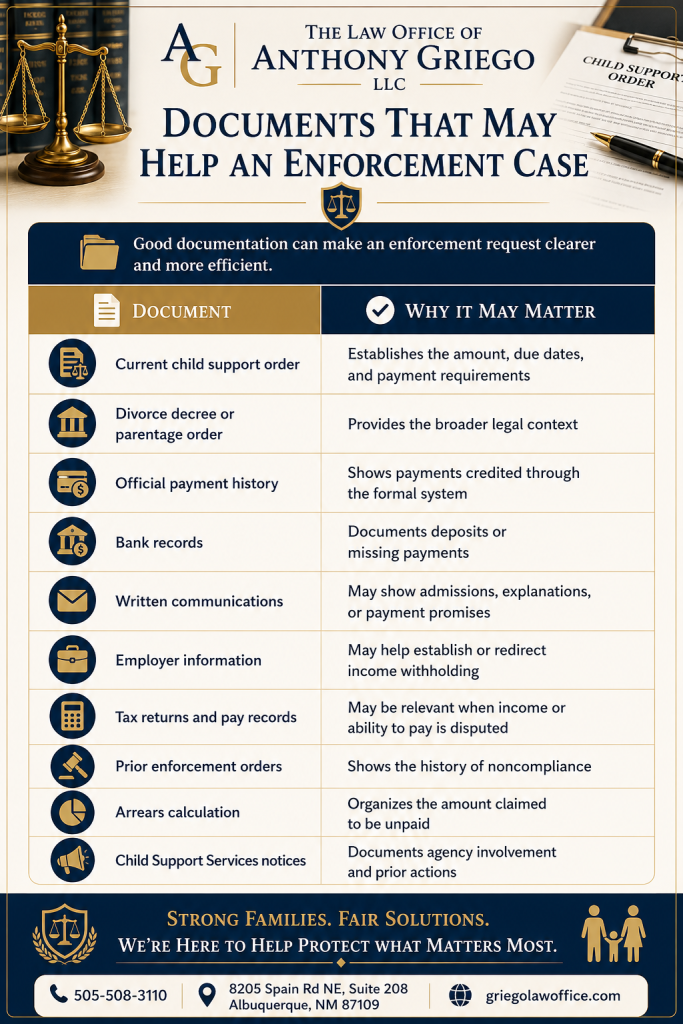
Organize records by date. Avoid altering screenshots, editing messages, or combining unrelated events into one narrative. Clear records are usually more persuasive than emotional accusations.
Common Mistakes to Avoid
Waiting Too Long
One missed payment may be a processing problem. Repeated missed payments should not be ignored. Delay can allow arrears to grow and make records harder to reconstruct.
Denying Parenting Time
Support and visitation are separate issues. Do not create a custody violation while attempting to address a support violation.
Threatening the Other Parent
Threats, harassment, and hostile social-media posts rarely improve an enforcement case. Keep communications calm, factual, and child-focused.
Accepting Unrecorded Cash
Cash can be difficult to prove. Use the court-ordered payment method whenever possible and provide receipts for any permitted direct payment.
Treating Gifts as Child Support
Clothing, toys, meals, travel, or school supplies do not automatically replace the ordered payment unless the court order or an approved agreement provides otherwise.
Calculating Arrears from Memory
Use the court order, official payment history, and reliable financial records.
Assuming Enforcement and Modification Are the Same
Enforcement addresses compliance with the existing order. Modification asks the court to change future support.
Expecting an Immediate Guaranteed Result
Court schedules, notice requirements, disputed evidence, agency procedures, and the paying parent’s financial circumstances can affect timing and outcome.
Frequently Asked Questions
What happens if my ex never pays child support?
The unpaid amounts may become arrears, and enforcement options may include income withholding, a motion to enforce, civil contempt, tax-refund interception, liens, or other remedies. The appropriate response depends on the order and case history.
Can unpaid child support be collected years later?
Past-due support may remain enforceable, but limitation periods, judgments, prior proceedings, the age of the debt, and other legal issues can affect collection. Older arrears should be reviewed by a New Mexico attorney rather than assumed to be either collectible or expired.
Does unpaid child support earn interest in New Mexico?
Yes. New Mexico law provides for four-percent interest on delinquent child support from the date the payment becomes delinquent until it is paid.
Can my ex go to jail for not paying?
Incarceration may be possible in a contempt proceeding involving willful noncompliance, but it is not automatic. The court considers the parent’s ability to pay and other circumstances.
Can wages be garnished?
A wage-withholding order can require an employer to deduct child support from income. New Mexico Courts provides forms for domestic-relations wage withholding.
Can tax refunds be intercepted?
Qualifying state or federal refunds may be intercepted through child-support enforcement procedures. Eligibility and required processes apply.
Can I stop visitation until my ex pays?
Generally, no. Continue following the custody and parenting-time order unless it is changed by the court or a genuine emergency requires immediate legal action.
What if my ex says the payment is no longer affordable?
The paying parent may seek a modification, but the existing amount generally remains due until a court enters a different order.
What if my ex moved to another state?
Interstate child support enforcement procedures may allow agencies or courts to coordinate across state lines. Moving does not automatically eliminate the obligation.
How can an attorney help enforce child support?
An attorney can review the order, calculate claimed arrears, organize evidence, identify the appropriate enforcement procedure, prepare court filings, respond to disputed claims, and represent you at a hearing.
When to Speak with an Albuquerque Child Support Attorney
Consider obtaining legal advice when:
- More than one payment has been missed
- Only partial payments are being made
- A substantial arrears balance has accumulated
- The paying parent changed jobs
- Income withholding stopped
- The paying parent is self-employed
- Income or assets may be concealed
- Your ex moved out of New Mexico
- You received notice of an enforcement hearing
- Child Support Services has not resolved the issue
- The other parent is requesting a modification
- The payment history is disputed
- You are unsure whether to file for enforcement or modification
Anthony Griego has handled complex divorce, custody, and child support matters and has served as a Guardian ad Litem in sensitive family cases. His earlier experience as an Assistant District Attorney included first-chair felony trial work, providing substantial courtroom and evidentiary experience that supports his family law practice.
Contact an Albuquerque Child Support Enforcement Attorney
When child support payments stop, your child’s financial needs do not.
You should not have to guess which enforcement procedure applies, whether the payment history is accurate, or how to present the matter to the court. A careful review of the current order and supporting records can help identify the most appropriate next step.
The Law Office of Anthony Griego LLC assists Albuquerque-area parents with child support enforcement, disputed arrears, income withholding, contempt proceedings, support modifications, custody matters, and other family law concerns.
The firm serves clients throughout Albuquerque, Bernalillo County, Rio Rancho, Sandoval County, Los Lunas, Valencia County, and other communities across Central New Mexico.
Contact The Law Office of Anthony Griego LLC at 505-508-3110 to schedule a confidential consultation and discuss your legal options.
The Law Office of Anthony Griego LLC
8205 Spain Rd. NE, Suite 208
Albuquerque, New Mexico 87109
Phone: 505-508-3110